

Recently, the medical-grade poly(L-lactic acid) (PLLA) filament independently developed by eSUNMed successfully completed the product registration and filing process, and simultaneously obtained the Medical Device Master File Registration Certificate (Registration No.: M2026275-000). This marks that this absorbable filament, specially designed for medical 3D printing scenarios, has completely passed the raw material qualification review at the regulatory level. Its physical and chemical properties, biosafety, production control, and process stability have all been incorporated into the official archiving system, clearing a key compliance channel for the R&D and registration declaration of downstream Class II and Class III implantable medical devices.

01. Robust PLLA Filament Expands Medical Application Boundaries
· Master file filing for worry-free qualification: It has completed the master file registration and filing, providing complete technical data support that complies with regulatory requirements, which greatly simplifies the declaration procedures for downstream implantable medical devices.
· Extremely high purity and biosafety: Prepared using high-purity poly(L-lactic acid) (PLLA) raw materials, with strict control over residual monomers and metal ion impurities.
· Excellent mechanical strength and durability: Thanks to its high molecular weight (400~500 kDa) and high crystallinity, the printed finished products possess high tensile strength, strong toughness, and stable dimensional accuracy.
· Precise filament diameter control: The filament diameter is controlled at 1.75 ± 0.05mm, combined with a high-precision extrusion process, ensuring a continuous and clog-free printing process.
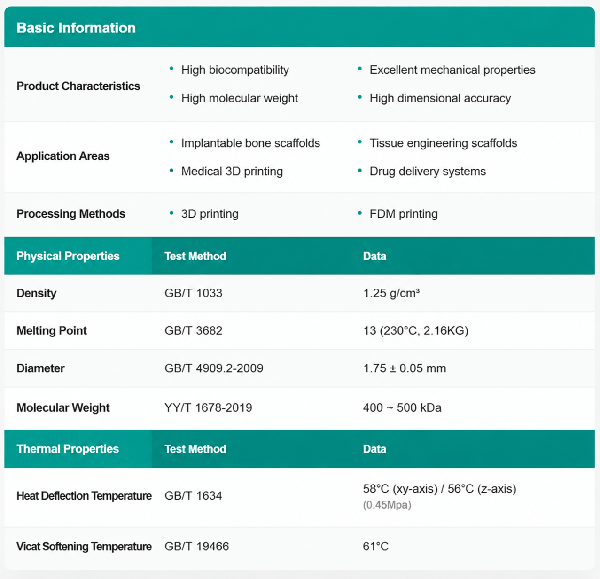
Table 1: Basic Information of PLLA Filament Products
· High-performance mechanical properties
Medical implant structures not only need to meet the manufacturing of complex forms but also must possess a certain mechanical load-bearing capacity. After standard testing, the PLLA filament exhibits good mechanical properties.
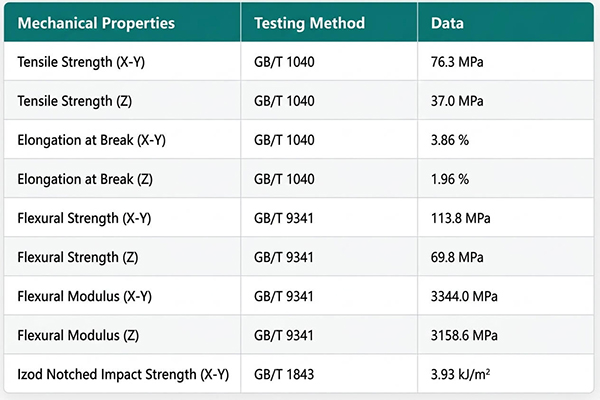
Table 2: Mechanical Properties of PLLA Printing
· Biocompatibility verification
Material safety is the core requirement for medical applications. The medical PLLA 3D printing filament has undergone biological evaluation tests in accordance with relevant standards, and has passed all routine biocompatibility test items.
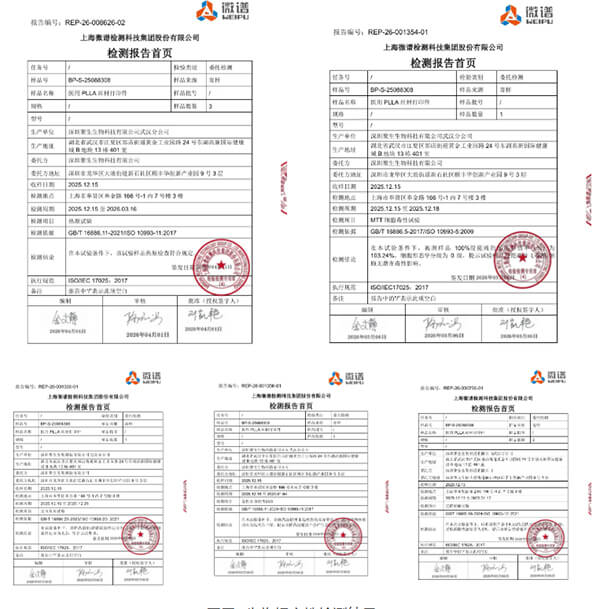
Figure 3: Biocompatibility Test Results
· Strong filament printing stability, suitable for precision medical components
It is equipped with mature printing parameters and slicing optimization schemes, adapting to the vast majority of FDM devices on the market, allowing for quick mastering without the need for repeated process debugging. The filament has a uniform diameter, no bubbles, and supports high-speed printing; it can be used to prepare high-precision bionic scaffolds, personalized maxillofacial / hand and foot implants, surgical guides, etc., with stable dimensional accuracy.
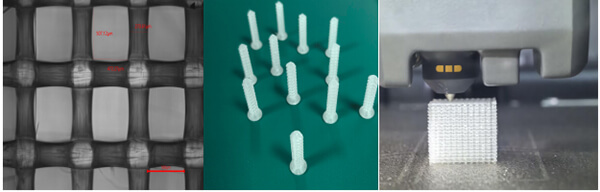
Figure 4: Printing Precision and Molding Performance
02. Material Innovation-Driven, Empowering Medical 3D Printing
· Materials are the core foundation for the development of medical 3D printing
For the innovative implementation of the medical 3D printing industry, a complete and high-performance medical material system is an indispensable key support. Material performance directly determines the molding effect of implant products and clinical application safety.
· Medical PLLA filament opens up a brand new technical route for regenerative medicine
The successful filing and implementation of the medical-grade PLLA 3D printing filament have expanded the categories of compliant medical printing consumables. At the same time, it has built a brand new and feasible technical path for the R&D and manufacturing of biodegradable implantable devices, tissue engineering scaffolds, and personalized medical components.
· Full-chain technical layout, delivering integrated medical material solutions
eSUNMed has long been deeply engaged in three major directions: medical polymer synthesis, precision 3D printing molding, and clinical application of regenerative medicine. It has completed multi-dimensional technical accumulation and can provide more stable and comprehensive supporting material solutions for various innovative R&D scenarios in medical 3D printing.
Based on the sector of compliant biodegradable medical 3D printing materials, eSUNMed will continue to delve into material modification and process innovation, empowering the development of regenerative medicine with a complete polymer material system, and helping more personalized biodegradable medical products move towards clinical application.